


Concentrates 101
Concentrates. Dabs. Wax. It doesn’t matter which term you use, it does not have to be an overwhelming product to try to sell. Resin, Rosin, and RSO are, simply put, the three main categories of concentrate we will be going over this time around. There are a few key items to remember when it comes to dabs:
The biggest thing in concentrates is HOW IT’S MADE. Resin and Rosin are the two we will be discussing right now.
RESIN - has been made with a solvent, typically BHO, where they typically blow the material through a tube of butane. Other examples of a solvent they may use are: ethanol, propane, and C02. It is not considered to be solventless because they are using another chemical (butane/ethanol/C02) to get the consistency.
ROSIN - has been pressed using only heat and pressure. They DO NOT use a solvent, so it’s SOLVENTLESS. They heat up the plates and smush the material between them, which turns it into a waxy, oil consistency. Solventless is the most pure form of dabs you can create.
Now that we know the difference between ROSIN and RESIN, let’s get into the differences between the two:
CURED - cured means it’s using a CURED plant (as in, been hung and dried in the traditional sense). Cured, dried, and turned into wax. They will typically have the higher THC percentage, but lose out on the terpenes and cannabinoids due to the creation process.
LIVE - live means they took a freshly chopped down plant, and flash froze it before turning it into wax. These will typically have a lower THC count, but because of the frozen plant, the terpene and cannabinoid percentage will be higher.
So, which is better? Cured or live? Resin or rosin?
Honestly, it’s preference. Some say the cured plant brings out a lot of great properties and is a more intense feeling of the actual plant. It will have a higher THC percentage (although we already know that it’s not only about percentage). Resin will be a more cost-effective option, since the yields tend to be higher, which allows them to sell more at a lower price option.
However, some say live is the way to go because you’re getting more of the cannabinoids and medicinal effects from the plant. Your terpene percentage will be higher, but the THC percentage will be lower compared to the cured. The return on rosin is not as much as resin - especially because different plants are better (or worse) for turning into concentrate (“washing”) than others, but then when you are only using heat and pressure, plus you’re not yielding as much, which is why rosin tends to come with a hefty price tag.
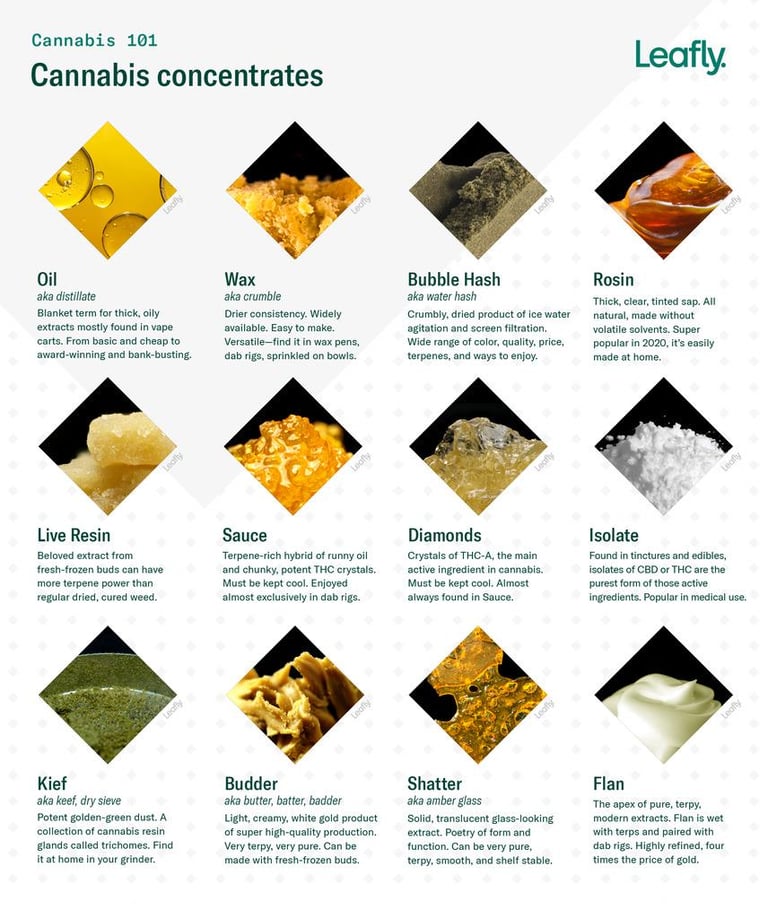
So what’s budder, batter, and shatter then???
Short answer: The consistency or texture of the concentrate.
Batter: slightly thinner than Budder, this is more like a cake batter consistency
Budder: peanut butter-like texture, similar to batter
Crumble: somewhere between a shatter and a sauce, there’s crumble that looks like crumbs and is easily pliable and scoopable. Lots of people like crumble because they can work with it, scoop it, and dab it without wasting too much. Crumble also doesn’t seem to get “sucked up” as quickly as sauce.
Diamonds: are made from THCA and they look like white crystals. While technically stronger than rosin, diamonds are the purest form of THC. Although technically stronger than rosin, it may not seem like it sometimes because rosin contains lots of terpenes, while diamonds don’t have any terpenes unless it’s been added back into sauce. Very potent, but also extremely bland tasting because of this
Sauce: more of an olive oil texture, more runny or liquid-like texture
Shatter: stable and glass-like that “shatters” into shards when broken
Snap and Pull ("Sap"): like shatter but stretches like taffy when pulled
Sugar: an appearance of wet sugar
Don’t worry if we haven’t covered all of these yet; there’s more to come, I just wanted you to see the differences between them all.
Cold Cure vs. Fresh Press:
So all this talks about is what they’ve done after the dab was made. Cold Cure refers to keeping it at a cold temperature to enhance the terpenes and save the consistency.
Fresh Press refers to leaving the dab at room temperature after it was created. You can turn your Cold Cure into a Fresh Press but you can’t turn your Fresh Press into a Cold Cure.
But Ash, you said RSO is a concentrate too! What’s the deal with that?
RSO, also known as Rick Simpson Oil, is one of the most versatile and highly acclaimed THC products on the market. Rick Simpson was a Canadian engineer and cannabis advocate who was drawn to cannabis activism by a work accident that led to many health issues. His story goes that he was able to resolve his health issues with RSO, the dark, tar-like cannabis extract that straddles the lines of concentrate, edible, and topical. There’s very little it can’t do, and a lot it can do for both patients and recreational consumers. Before we get into what it can do, here’s a little history lesson on the reason he even created it in the first place.
In 1997, Rick was tasked with clearing out asbestos from a boiler room. During this, he became very dizzy and fell off his ladder. After he fell, he was rushed to the emergency room, where he ended up having tinnitus (ringing of the ears) and dizzy spells. At this point, he looked to medical marijuana to alleviate his symptoms although his doctor advised against it because it was still illegal. Following the success of using medical marijuana to relieve his symptoms, he ended up developing skin cancer (basal cell carcinoma) in 2003 and he was looking to see if he would have success with using cannabis for this as well, especially with the Canadian government legalizing the use of cannabis for medical purposes.
His recipe is based on creating a product that produced the same results as a 1975 study, which showed cannabis killing cancer cells in mice. Because medicinal marijuana is a more recent thing, there are not a lot of studies that show the effectiveness of RSO over long-term use, but anecdotally, RSO has helped patients manage conditions such as multiple sclerosis, epilepsy, cancer, insomnia, chronic pain, and asthma, among many others.
RSO is generally safe to use with other drugs, and will not cause interactions with cancer medications. Despite this, it is still best to avoid using RSO with antidepressants, opioids, or sedatives. Generally, dosage is different for everyone. A variety of factors such as age, sex, and health factors will determine the amount of RSO needed. The standard protocol for Stage 2-4 cancer is a minimum of 60 grams over 90 days. Many patients will continue on smaller maintenance doses, even when they are “cancer free.” RSO is also available in suppository, tincture, capsule, and even edible form, such as gummies.
It is possible to cook with RSO as well. Instead of using cannabutter, simply replace it with RSO. You can even mix RSO into sauces, salad dressings, and beverages. It is recommended to start with smaller amounts, and gradually increase to find the perfect mix. Cannabis edibles made with RSO tend to be more potent, so you’ll need less than expected.
Because of how it’s made (a long process but his recipe can still be found on his website www.ricksimpsonoil.com ) it is considered a concentrate.
That’s where we are going to end this one for now.
We will go over even more concentrates (like other oils, kief, and hash!), different consumption methods (and why it matters!), and some more details in Concentrates 102.
Subscribe For Updates!
Quick Contact
GreenWCannabis@AndNightUpLate.com
231-442-9199
Muskegon, MI 49442